
Hoffman’s Hierarchy of Podcast Needs

I’ve seen a lot of posts on LinkedIn that drive me a little crazy. They say some variation of this:
“Why buy expensive mics and cameras? You don’t need all that fancy-schmancy stuff to make a successful podcast – just make good content.”
This is a half-truth at best.
It makes me think of a famous formulation called “Maslow’s Hierarchy of Needs”. This was created by a psychologist named Abraham Maslow, and it lists all the things that human beings need to live a happy and fulfilled life – from food and water to love and professional fulfillment – ranked in an order of urgency.
The idea here is that everyone wants companionship, but you can’t dedicate time and energy to finding it if you’re busy being worried about having enough food to eat. In thinking about this, Maslow created a pyramid, with the most fundamental needs – air, food, water, shelter, clothing – at the bottom, stuff like employment and health care in the middle, and more abstract things like self-esteem at the top.
The point here isn’t that the top-of-the-pyramid items – feeling loved and appreciated, spending your time in ways that you find meaningful – are unimportant. You cannot live a happy life without them. But the top of the pyramid items cannot be addressed before the ones below them. It’s not a hierarchy of important things over unimportant ones, but rather an order of operations: start with this problem, then move on to this one, then this one, until you reach the top.
And that’s what the “forget the fancy-schmancy” posts are: you do need the fancy schmancy (so to speak) for your podcast to be all that it can be, but it’s not the first thing you need.
And so, with apologies to the good Dr. Maslow, I present what I will call…
Hoffman’s Hierarchy of Podcast Needs:
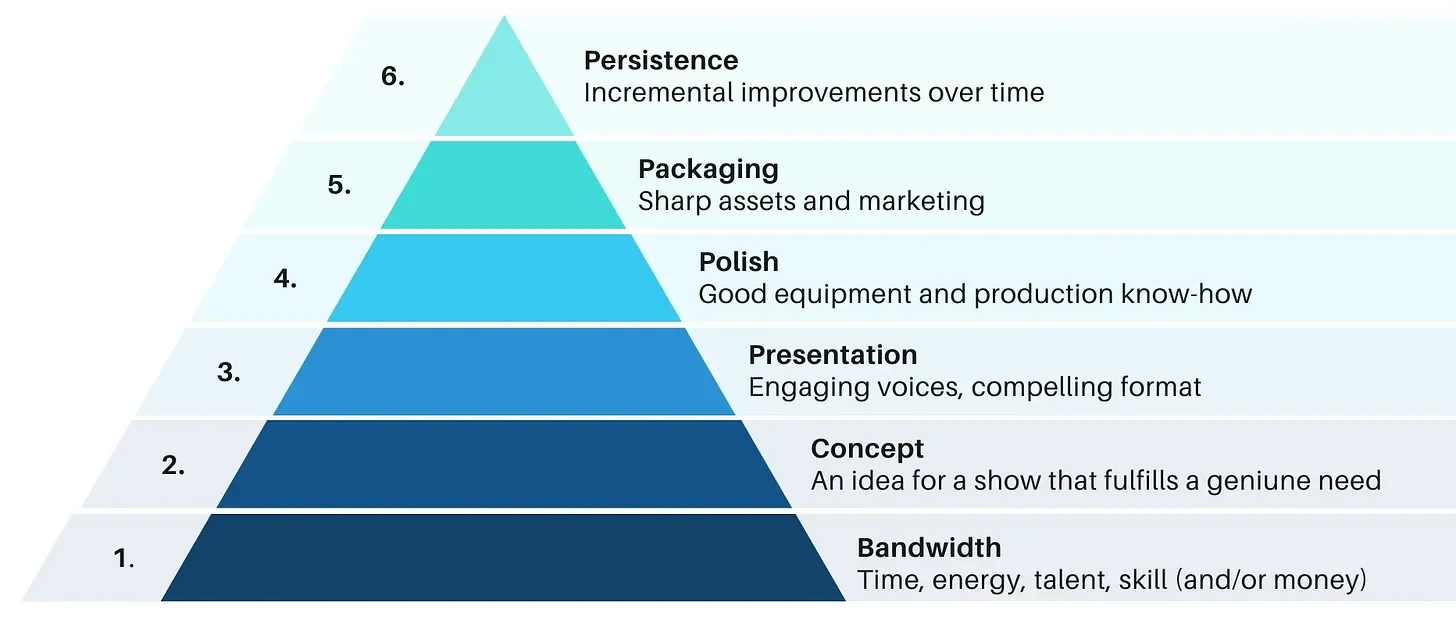
At the bottom is Bandwidth, and this is really the basis of everything. No matter what the AI snake oil salesmen will tell you, producing good media is hard work, and someone is going to have to do it. It can’t just be anyone doing it, though, because it’s also work that takes a particular set of talents and skills. You have to be good at telling a story and willing to put the time into finding good stories to tell. And no matter how un-fancy-schmancy your show, there is going to be some level of technical expertise involved in recording and publishing it. Someone either has to have those skills or be willing to put the time into developing them.
Fortunately for those with a lack of time and/or talent, there is a magic potion that can substitute for either of them. This is, of course, money. People with skill and an open calendar can be hired.
These are the most fundamental requirements. Without a sufficient investment of some combination of time, talent, and money, you are dead in the water, and nothing higher up the chain will make any difference.
The second level is Concept. Who are you talking to, and what are you going to say, and why? Far too many people launch a media project without giving this much serious thought, rendering all that follows compromised, if not worthless.
People listen to a new series (or watch one) because it fills a need in their lives – it either teaches them something they want to know, makes them laugh, gives them a thrill, inspires them, or some combination of these things. To find success you have to choose the right target and aim at it properly – how will what we’re going provide one of these things, and in a way that they can’t get elsewhere?
Only after answering that can we climb to the third rung in the ladder: Presentation. Now that we have a good idea of what we want to say and why, how are we going to say it and who is going to do the saying? Charming, relatable on-air talent and ear-catching formal elements: good music, interesting recurring segments, and so forth, are the things that lift a show from “that’s a good idea” to “you should listen to this”.
Now can we move to Polish: what equipment and other resources will we need to execute that concept and format in the best way we can?
I think the myth of “you don’t need the fancy-schmance” often comes from placing this step in the wrong place in the chain. When people start the process by buying equipment, they very often over-purchase or just buy the wrong things.Mics and cameras and software aren’t interchangeable, and “the best one” very much depends on what you are trying to accomplish. It often happens that we’re brought in by a client who had already built and outfitted a podcast studio, at great expense, only to discover that they didn’t have the right things to make the show that would achieve their goals.
You have a much better chance of achieving high production values at a reasonable price if you’re getting specific the tools you need to make the show you want to make, which of course you can’t know until you’ve done all the creative work on the lower rungs.
And so, now that we have a team, a goal, a concept, a format, and a production plan, it’s time to think about Packaging: how will that audience discover this series so they can then fall in love with it? However great your show looks and sounds, if the materials that surround it are ugly – the logo, website, social assets, and so forth – it’s much harder to get people to give it a chance, and without a plan for promotion and audience building, they won’t find it to begin with.
Which brings us to the top of our pyramid: Persistence. This is the gumption to keep going, episode after episode, season after season, and also the willingness to observe and modify: what works and what doesn’t? What are people responding to and what is leaving them flat? How can we make the next episode better than the last one?
All of these things are necessary to make your podcast all that it can be, but they won’t make sense if you address them out of order. So, when someone tells you that you don’t need expensive mics or professional graphic design or paid promotion, consider the possibility that you really do need them, just maybe not yet.